
Vietnam SPC manufacturing is emerging as the top choice for China+1 strategies. 40%. That is the share of ex-China manufacturing advisory work in the caseload of international trade law firm Harris Sliwoski — up from just 10% five years ago. (Source: Harris Sliwoski LLP, 2024)
This is not the individual decision of a handful of companies. It is a systemic signal: global supply chains are restructuring, and multinationals are searching for the answer to the same question — which manufacturing location outside China can serve the US and European markets with competitive cost, sufficiently high standards, and lower geopolitical risk?
For the stone plastic composite (SPC) flooring industry, the answer is converging on Vietnam — not for lack of alternatives, but because Vietnam is the only Southeast Asian destination that combines all five factors at once: a mature manufacturing ecosystem, favorable logistics positioning, the region’s broadest free trade agreement network, competitive costs, and political stability sufficient to justify long-term investment.
This analysis does not attempt to argue that Vietnam is a perfect choice — no manufacturing location is. Instead, it provides a substantive evaluation framework for sourcing leaders to determine whether Vietnam is the right destination for a given part of their product portfolio.
PART I — THE STRATEGIC PICTURE For senior leadership and Chief Procurement Officers: VP Sourcing, Chief Procurement Officer, VP Manufacturing |
1. Three Converging Pressures: Why This Wave of Restructuring Is Different
The decision to diversify supply chains beyond China does not come from a single cause. Three pressures are converging simultaneously, and any one of them alone would be enough to trigger a multinational’s sourcing-strategy reassessment.
- Tariff pressure: Since 2018, US–China tariffs have escalated across multiple rounds — Section 301 (trade retaliation measures), Section 232 (national security tariffs), and 2025 adjustment rounds — creating a substantive cost gap between China-origin and non-China-origin goods. For SPC flooring, the 10–25% tariff differential on Chinese goods has completely transformed the sourcing cost equation: many US distributors are forced to seek alternative sourcing not by choice, but by structural pressure.
Supply chain pressure: The COVID-19 pandemic exposed geographic concentration risk with measurable cost. The share of ex-China manufacturing advisory work at Harris Sliwoski rose from 10% to over 40% in five years (Harris Sliwoski, 2024) — reflecting an industry-wide shift, not the individual decision of a handful of companies.
- Environmental, Social, and Governance (ESG) pressure: Western buyers — especially in green-building and large-scale commercial segments — increasingly require suppliers to provide transparent supply chain records: labor conditions, carbon footprint, and material origin. A Vietnamese manufacturer with a third-party audit record and a traceable supply chain can meet this requirement far better than a rushed subcontracting model.
Why is SPC particularly well-suited to Vietnam? Not every industry fits the China+1 model in Vietnam. SPC has a specific reason: its manufacturing process is complex enough to create genuine value-add — clearing the “Substantial Transformation” threshold that US customs authorities require — yet not so complex that it demands China’s hyper-specialized technical ecosystem, and Vietnam already has years of accumulated manufacturing ecosystem — a starting point that Indonesia or Thailand cannot quickly replicate.
▶ Action Implication The strategic question for a sourcing leader is not “is Vietnam a fit” but “which part of our sourcing portfolio is best suited to shift to Vietnam over the next 12–24 months?” That answer varies by price tier, volume, and target market for each product line. |
2. Five Key Advantages of Vietnam SPC Manufacturing
Advantage 1 — A Mature Manufacturing Ecosystem: Not a Fresh Start
This is the most fundamental difference between Vietnam and emerging alternative manufacturing destinations such as Indonesia or Bangladesh in the flooring industry. Vietnam is not a greenfield destination for this industry — it is a market with an ecosystem accumulated over multiple generations.
2024–2025 customs data records 2,513 businesses active in the SPC raw-material import and manufacturing chain — creating diverse processing capacity that multinationals can tap into without building from scratch. An export/import ratio of 12.2x confirms Vietnam is operating as a genuine manufacturing hub — converting inputs into export products — rather than a domestic consumption market. February 2025 export growth of +54.4% year-on-year confirms the industry is in a genuine growth phase. (Source: Vietnam Customs Data, Jan 2024 – Oct 2025)
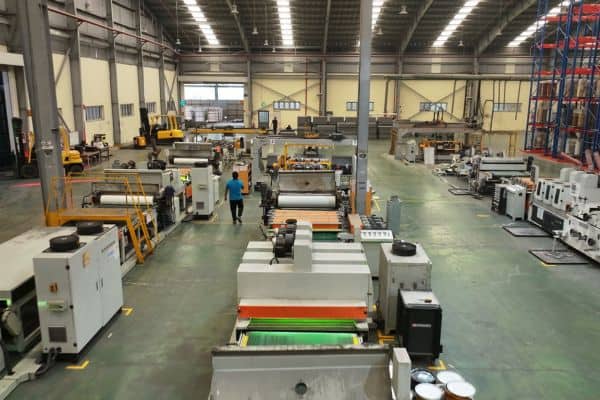
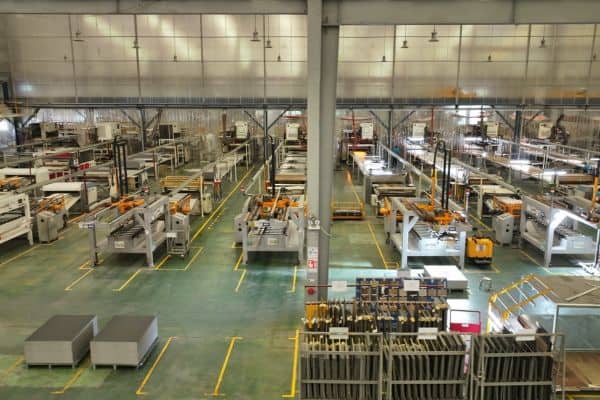
A supporting ecosystem critical to multinationals has formed: packaging suppliers, underlayment, click-lock accessory makers, container logistics contractors, label printing units, and customs declaration compliance providers. The technical workforce operating extrusion presses, calibration machines, and quality-control lines has been through multiple cycles of in-house industry training — no need to train from zero.
Advantage 2 — Southern Logistics Position: A Quantifiable Geographic Edge
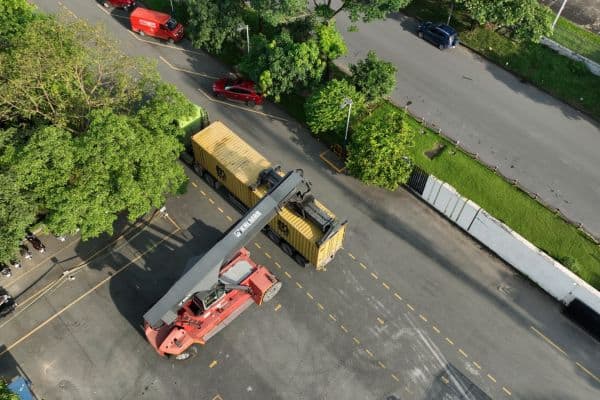
The Cat Lai/Tan Cang port cluster in Ho Chi Minh City is one of Southeast Asia’s busiest container ports, with direct routes to Los Angeles/Long Beach — the top destination for SPC flooring exported to the US.
Origin | Transit Time to LA/Long Beach | Notes |
Ho Chi Minh City (Cat Lai) | ~18–20 days | Direct route, multiple sailings/week |
Bangkok (Laem Chabang) | ~22–25 days | Shallower port, requires smaller vessels |
Jakarta (Tanjung Priok) | ~22–26 days | — |
Guangzhou/Shenzhen (China) | ~14–16 days | Geographic advantage neutralized by the 10–25% tariff differential |
More important than transit time is schedule reliability. Ho Chi Minh City has more direct sailings to North America than Bangkok or Jakarta, reducing the risk of transshipment through an intermediate port — a risk that causes unpredictable delays in a distributor’s inventory planning. For factories in the northern industrial parks (Hung Yen, Bac Giang), Hai Phong port serves the Northeast Asia route well but adds 2–3 days of transit compared to Ho Chi Minh City to the same US West Coast destination.
Advantage 3 — Southeast Asia’s Most Comprehensive Free Trade Agreement Network
This is the single most important advantage for a multinational with a multi-market strategy. As of 2025, Vietnam has 17 free trade agreements in force with more than 60 trading partners — the broadest network in the Southeast Asian region (TPSO Thailand, Nation Thailand, March 2024).
Country | CPTPP | EVFTA/EU FTA | UKVFTA | Current FTA Count |
Vietnam | ✅ (2019) | ✅ (2020) | ✅ (2021) | 17 |
Thailand | ❌ (none yet) | ❌ (negotiating) | ❌ | ~14 |
Indonesia | ❌ (applying to join) | ❌ (negotiating) | ❌ | ~14 |
China | ❌ | ❌ | ❌ | ~20 (no US/EU/UK) |
Vietnam is the only Southeast Asian country with simultaneous membership in: CPTPP (Canada, Australia, Chile, Mexico, Peru…) + EVFTA (27 EU countries) + UKVFTA (United Kingdom) + RCEP (all of ASEAN plus China, Japan, South Korea). For a multinational needing a single manufacturing location to serve the maximum number of markets with preferential tariffs, Vietnam is the only ASEAN choice that satisfies this condition.
Advantage 4 — Competitive Manufacturing Costs: Real Numbers and an Honest Trend
Market | Labor Cost/Hour | Labor Cost/Month | Total Monthly Operating Cost |
Vietnam | ~US$3 | ~US$302 | ~US$79,000 |
China | ~US$6.50 | ~US$770 | ~2x higher |
Thailand | ~US$4–5 | — | ~US$142,000 |
Indonesia | ~US$2.80 | — | ~US$65,000 (shallower industry ecosystem) |
Cambodia | ~US$1.50–2 | — | ~US$65,000 (more limited infrastructure and ecosystem) |
Source: BCG Global Manufacturing Cost Analysis; GSO Vietnam via Vietnam Briefing 2024; InCorp Vietnam 2025; Dragon Sourcing 2024
⚠ A Trend to Factor Into Long-Term Financial Models Vietnam’s labor costs are rising steadily — the minimum wage rose ~6% in 2023 (ILO). PwC forecasts Southeast Asian labor costs rising under 4%/year through 2025, lower than China (~6%/year). Multinationals need to factor cost growth into a 5–7 year model, not just first-year cost. Additionally, Vietnam’s domestic logistics costs remain higher than ideal — a point to negotiate in contract structuring. |
Advantage 5 — Political Stability and an Improving Investment Environment
Vietnam maintains consistent political stability — a factor many multinationals value more highly than short-term cost advantage when building a manufacturing footprint for 10–15 years. According to the World Bank’s Business Ready Index (which replaced the Ease of Doing Business Index starting in 2023), Vietnam shows continuous improvement in business-formation and customs-clearance procedure indicators.
Three real challenges that deserve honest presentation: (1) Intellectual property protection remains a weakness compared to Singapore or Taiwan — multinationals need tight confidentiality agreements and should not share proprietary designs before clear legal protection mechanisms are in place; (2) Administrative procedures, particularly for new foreign direct investment, can still take longer than expected — reflected in AmCham and EuroCham’s annual Business Confidence Surveys; (3) Currency risk needs to be managed within the contract payment structure.
▶ Action Implication Combining the region’s broadest FTA advantage with competitive costs and a mature ecosystem, Vietnam is the only ASEAN manufacturing location serving the US, EU, UK, and CPTPP markets simultaneously with preferential tariffs. Not Thailand, not Indonesia, not Malaysia — no other destination in the region combines all three layers: CPTPP + EVFTA + UKVFTA. |
3. Four Common Partnership Models: A Substantive Analysis
Model | Characteristics | Best Fit When | Risks to Manage |
Model 1 — Contract Manufacturing (CMO) | The multinational defines all technical specifications. The manufacturer owns the factory and processes. The multinational owns the brand and customer relationship. | Wants quality control without committing capital to a factory. Suited to a pilot phase or when volume doesn’t yet justify a joint venture. | Dependent on CMO capability. Requires regular audits to maintain standards. |
Model 2 — Private Label Manufacturing (OEM/ODM) | The Vietnamese manufacturer participates in product design and development per the multinational’s brief. The partner provides R&D and production capability; the multinational provides brand and market. | Wants a differentiated-design private label without investing in in-house R&D. | Needs a clear agreement on design ownership. The partner needs genuine product-development capability, not just manufacturing. |
Model 3 — Joint Venture | The multinational co-invests with a Vietnamese partner to form a new legal entity. Shared factory ownership, management decisions, and profits. | Plans a long-term presence in Vietnam. Wants to optimize EVFTA and CPTPP rules-of-origin. Needs control over capacity expansion per specific needs. | Governance-culture risk — pricing decisions, profit distribution, and re-equipment investment. Requires careful legal drafting by a Vietnamese trade lawyer. |
Model 4 — Equity Investment in a Vietnamese Manufacturer | A private equity fund or strategic investor buys equity in an operating Vietnamese SPC manufacturer. | Wants portfolio exposure to Vietnam’s manufacturing growth story, or a strategic buyer wants a faster footprint than building from scratch. | The common “commercially promising but capital-starved” pattern. Requires thorough due diligence on compliance records and genuine buyer-relationship foundations. |
💡 A Real Investment Opportunity Today
Many mid-sized Vietnamese SPC manufacturers lack the capital to upgrade certifications (FloorScore, EN 14041), invest in testing equipment, and expand capacity — while having a verified export track record and a genuine buyer-relationship ecosystem. This “commercially promising but capital-starved” pattern commonly appears at this stage of an industry’s development. A strategic investor with capital and certification-upgrade capability could create significant value from this structure.
PART II — AN EXECUTION GUIDE For middle management: Purchasing, Import/Export, Compliance, Engineering |
4. Ten Partner-Selection Criteria: A Practical Framework for Sourcing Leaders
The framework below applies to contract manufacturing, private-label manufacturing, and joint-venture partnerships alike. No partner is perfect — but there are minimum thresholds that cannot be compromised.
Technical Criteria — Non-Negotiable
- ISO 9001 (Quality Management) and ISO 14001 (Environmental) — a prerequisite for any relationship lasting beyond 6 months. No ISO 9001 means no genuine quality-control system.
- Third-party factory audit within the last 18 months (SGS, Intertek, Bureau Veritas, or WRAP for labor compliance). Self-audits carry no evidentiary value with most Western distributors.
- An in-house testing lab equipped to check at minimum: thickness, wear-layer thickness, dimensional stability, and basic volatile organic compound testing — or a standing contract with an internationally accredited third-party lab.
- Minimum production capacity for the multinational’s product line with a 20–30% flexibility margin — avoid a partner where the multinational would occupy more than 70% of capacity, creating dangerous mutual-dependency risk.
Compliance Criteria — Legal and Commercial Risk
- Clear and consistent Certificate of Origin — particularly Form B (most-favored-nation status) and Form EUR.1 (UKVFTA). A traceable Certificate of Origin issuance history from VCCI or the competent authority.
- A consistent customs-code declaration history over the last 3 years — no sudden HS-code shifts coinciding with new tariff orders.
- No customs disputes, anti-dumping violations, or anti-circumvention investigations in the last 3 years — verifiable through public customs data.
- Labor compliance: legal working age (18 and above), no evidence of forced labor, working conditions aligned with ILO core standards. This is the minimum ESG requirement for most Western buyers.
Business Criteria — Relationship Sustainability
- Financial stability: the last 3 years of financial statements — not a guarantee, but an indicator of operational health. Pay particular attention to short-term debt ratio and operating cash flow.
- Customer diversification: avoid a partner deriving more than 40% of revenue from a single customer — when that customer cuts orders, the partner comes under financial pressure and may fail to meet the multinational’s production plan.
▶ Action Implication Before meeting any manufacturer, print this 10-criteria list and request documentation for each point at the first meeting. A partner unable to provide documentation for technical and compliance criteria by the second meeting should be re-evaluated — not for lack of goodwill, but because their documentation system isn’t robust enough to withstand audit pressure from Western buyers. |
5. Implementation Realities of Vietnam SPC Manufacturing: What Multinationals Need to Prepare For
Challenge | Real-World Manifestation | Practical Solution |
Language barrier | Most mid-sized Vietnamese SPC manufacturers lack an English-language team strong enough to handle technical negotiations, spec documentation, and complaint management. | This isn’t a manufacturing-capability problem — it can be solved with a local consultant or a specialized flooring sourcing agent. |
Intellectual property protection | Although UKVFTA and EVFTA contain IP-protection clauses, enforcement remains a real challenge. | Do not share proprietary designs, special compound formulas, or trademark registration samples during preliminary negotiations before an NDA is signed and confirmed by local counsel. |
Realistic implementation timeline | From first contact to the first quality-compliant production shipment: 6–12 months is a realistic estimate. | Search (1–2 months) → Audit and due diligence (1–2 months) → Sample development and testing (2–3 months) → Negotiation and contract signing (1–2 months) → Trial production and quality control (1–2 months). |
Minimum order quantity (MOQ) requirements | Many mid-sized Vietnamese manufacturers require a minimum of one 40ft container (~500–600 m² depending on product) to justify machine setup. | Larger manufacturers tend to be more flexible but require a long-term relationship before lowering minimums. Propose an annual volume commitment rather than negotiating order by order. |
The Most Effective Partner-Sourcing Channels
- Industry trade shows: Domotex Hannover (January–February annually, with a Vietnam pavilion), Vietbuild (3 editions/year), Vietnam Expo.
- VCCI (Vietnam Chamber of Commerce and Industry): maintains a verified-manufacturer database and B2B matchmaking services.
- AmCham Vietnam and EuroCham: business-networking events and industry working groups.
- Specialized flooring sourcing agents: cost of 3–5%, but saves 3–6 months of search time and reduces the risk of choosing the wrong partner.
Who’s a Good Fit — and Who Isn’t: An Honest Assessment
Vietnam is not a sourcing solution for every multinational and every product line.
Group | Fit Level | Reason |
Best fit | US/UK/Canadian flooring distributors seeking to replace China sourcing in the mid-to-premium segment. Building-materials groups wanting an ASEAN manufacturing footprint that leverages CPTPP + EVFTA + UKVFTA simultaneously. Private equity funds seeking exposure to Vietnam’s manufacturing-growth story, backed by a 26+ year ecosystem and double-digit export growth. | Combines the region’s broadest FTA network + a mature ecosystem + growth confirmed by data. |
Less of a fit | Multinationals needing extremely large volume (>10 million m²/year) from a single manufacturer. Multinationals needing entirely new product R&D requiring a hyper-specialized polymer-chemistry ecosystem. Multinationals prioritizing under-3-month time-to-market. | Vietnam does not yet have many single manufacturers at >10 million m²/year scale. China still dominates specialized polymer R&D. Logistics and administrative procedures do not yet reliably support a <3-month timeline. |
One Action for the Next 7 Days
Take your SPC product portfolio currently sourced from China and segment it by two criteria: annual export volume and primary target market. Any product line with a volume of 500,000–3,000,000 m²/year and a target market of the US, UK, Canada, or Australia falls within the “sweet spot” for evaluating Vietnam sourcing — this is the zone that Vietnam’s current ecosystem and trade-agreement advantages support best.
In an industry where Vietnam is the only Southeast Asian manufacturing location with simultaneous CPTPP + EVFTA + UKVFTA membership — and an ecosystem accumulated over 26+ years — the question is not “should we shift sourcing to Vietnam” but “how much longer before your competitor plants their flag here first?”
Data Sources and Disclaimer
BCG Global Manufacturing Cost Analysis (Boston Consulting Group); GSO Vietnam — manufacturing wages ~7 million VND/month (~US$302), 2024; ILO Asia-Pacific — Labor Standards and Minimum Wage Update 2023
InCorp Vietnam — Competitive Operating Costs Analysis 2025; Dragon Sourcing — China vs Thailand vs Vietnam Manufacturing Cost Comparison 2024
Harris Sliwoski LLP — Global Manufacturing Intelligence: China vs Vietnam 2024
Vietnam FTA Network Data — Thailand TPSO vs Vietnam FTA Comparison (Nation Thailand, March 2024); InCorp Vietnam — Guide to Vietnam’s 17 FTAs 2024
CSIS — Two Years into CPTPP: Vietnam Trade Analysis; UK Government — UK Accession to CPTPP, December 2024
Vietnam Customs Data (Jan 2024 – Oct 2025, ~278,000 records, export/import ratio and growth rate). Reference exchange rate: 1 USD ≈ 25,000 VND
This report is for informational and independent strategic-analysis purposes only. It is not legal or investment advice. Sourcing and investment decisions should be supported by on-the-ground due diligence and independent local legal counsel. No specific company is named.