
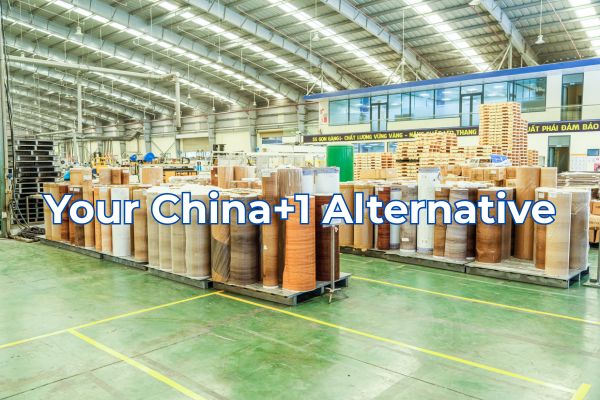
“China+1” — keeping part of a supply chain in China while deliberately building a second sourcing base elsewhere — has become a standard risk-management approach across manufacturing categories over the past several years. For SPC flooring specifically, the driver isn’t a general tariff differential; it’s something more targeted and, frankly, more forceful.
The specific driver: anti-dumping duties, not just tariffs
The China+1 approach has become a practical way for importers to strengthen supply chain resilience without completely shifting production away from China. Instead of relying on a single manufacturing base, buyers diversify their sourcing across multiple countries to reduce exposure to trade uncertainties, logistics disruptions, and changing regulations. For the SPC flooring industry, Vietnam has emerged as one of the most attractive alternatives thanks to its growing manufacturing capacity, export experience, and strong position in global supply chains. As a result, many distributors and private-label brands are incorporating Vietnam into their China+1 sourcing strategy to improve long-term flexibility while maintaining consistent product quality and reliable delivery.

The US has imposed anti-dumping duties on Chinese-made SPC flooring, and the range is unusually wide — reportedly anywhere from about 1% up to 240% depending on the specific Chinese exporter involved. That’s not a flat country-level tariff; it’s a case-by-case determination, which means the practical effect on any given import depends heavily on exactly which factory the product came from. The EU is conducting a similar anti-dumping investigation into Chinese SPC flooring as well (IndexBox’s analysis of SPC flooring trade flows and anti-dumping measures). For buyers, that combination — a wide, exporter-specific duty range plus a second jurisdiction now investigating the same issue — creates a genuinely elevated level of sourcing risk concentrated specifically on Chinese-origin SPC, distinct from the general China+1 conversation happening across other product categories.
Vietnam as the direct beneficiary
Vietnam is one of the clearest beneficiaries of that shift, alongside Thailand. Vietnam’s share of world SPC trade is estimated at around 8–12% and growing, within a global SPC market that’s itself expanding from roughly $4.22 billion (2026) to a projected $7.64 billion by 2035 (IndexBox’s world SPC flooring market analysis; 360 Research Reports’ global SPC market figures). Vietnam’s own domestic SPC market is also growing faster in percentage terms than the global average — a CAGR of roughly 10.3%, from about $312.4 million (2024) toward a projected $562.3 million by 2030 (Newstrail’s coverage of the Vietnam SPC flooring market) — which reflects both export demand and rising domestic construction activity, not tariff arbitrage alone.
Worth being direct about, in the same spirit as the broader China+1 conversation happening across industries: moving order volume to Vietnam doesn’t automatically eliminate every supply chain question a buyer should ask. Verifying that a specific supplier’s SPC core formulation and finishing genuinely happens in Vietnam — not merely final packaging of imported components — is exactly the kind of documentation question worth raising directly with any prospective supplier, Tín An included.
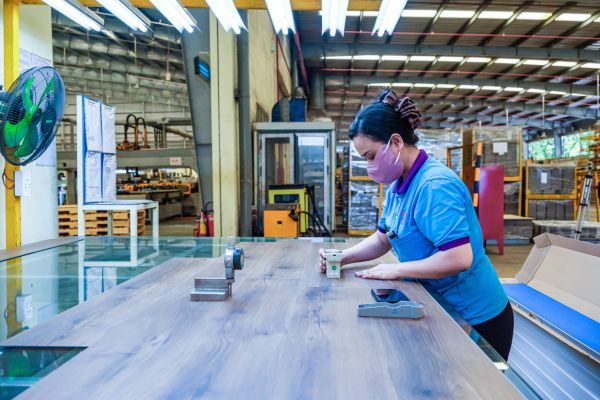
Where Tín An fits Tín An has been manufacturing SPC flooring in Vietnam for 26+ years, with an existing export footprint across more than 20 countries including the US, Canada, and the EU — which means the shift toward Vietnam sourcing isn’t a new capability we’re building in response to the tariff situation; it’s an existing track record you can verify directly, including through the certification and factory-audit questions covered in our buyer’s vetting checklist.